 Admin
Admin Vitamin C for Pigmentation
Vitamin C (ascorbic acid) is a clinically proven antioxidant that inhibits tyrosinase — the key enzyme responsible for melanin production in skin. By blocking this enzyme, Vitamin C prevents new dark spots from forming, gradually fades existing hyperpigmentation, and brightens overall skin tone. For Indian skin, which is genetically prone to excess melanin production and post-inflammatory dark marks, Vitamin C is one of the most evidence-backed and dermatologist-recommended brightening ingredients available.
If you have Indian skin, pigmentation is likely not just a cosmetic concern — it is a daily reality. Whether it is stubborn sun tan on the forehead, melasma patches on the cheeks, or dark marks left behind by every pimple, uneven skin tone affects millions of Indians regardless of age or gender. And if you have spent any time researching solutions, one ingredient keeps surfacing — Vitamin C.
But alongside the praise comes a lot of confusion: Which form of Vitamin C is best? What concentration is right for my skin? Can I mix it with niacinamide? Does it really work on deep pigmentation? This guide answers every one of these questions — backed by dermatological research, grounded in real Indian skin science, and written so you can actually apply it starting today.
1. Understanding Pigmentation — Why Indian Skin Is More Prone
Pigmentation simply refers to some areas of skin appearing darker than the surrounding skin. This occurs when melanocytes — the pigment-producing cells in the skin — become overactive and deposit excess melanin in uneven patches. Melanin itself is a protective pigment; it shields the skin from UV radiation. But when it is produced unevenly or in excess, it results in the dark spots, patches, and dullness that so many Indians struggle with.
Indian skin (Fitzpatrick Types III–VI) has more active melanocytes than lighter skin tones. This is actually a biological advantage — it means we have natural UV protection built in. But there is a significant trade-off: our melanocytes are far more reactive. Any trigger — sun exposure, inflammation, hormonal fluctuation, or even a small skin injury — can cause them to dump excess melanin into the upper skin layers. This makes Indian skin significantly more prone to the following types of pigmentation:

Sun Tan and Sun Spots (Solar Lentigines): India receives intense UV-A and UV-B radiation year-round, and even brief unprotected sun exposure can trigger visible tanning on Indian skin. The forehead, nose, and cheeks — areas most directly exposed to sunlight — are the first to darken. Repeated sun exposure without SPF leads to solar lentigines: flat, well-defined dark patches that deepen over time and become increasingly difficult to treat without consistent intervention.
Post-Inflammatory Hyperpigmentation (PIH): This is the most common pigmentation complaint in Indian skin clinics. Any skin trauma — acne, waxing, insect bites, rashes, or even aggressive scrubbing — triggers an inflammatory response. As the inflammation heals, melanocytes overreact by producing excess melanin as a protective response, leaving behind a flat dark mark where the injury was. On Indian skin, these marks can persist for months to over a year, long after the original injury has healed. PIH is not a scar in the structural sense — there is no collagen damage — but it is equally frustrating and equally in need of targeted treatment.
Melasma: Melasma presents as symmetrical, brownish or grayish patches — typically on the forehead, upper cheeks, upper lip, and chin. It is strongly driven by hormonal changes: pregnancy (called chloasma), oral contraceptives, and thyroid dysfunction are major triggers. Sun exposure dramatically worsens melasma by stimulating melanin production in already-sensitised skin. Among Indian women, melasma is one of the most common reasons for dermatology consultations, and it is also the most stubborn type of pigmentation to treat — requiring a multi-ingredient, long-term approach.
Periorbital Hyperpigmentation (Dark Circles): In Indian skin, dark circles are not merely a sign of poor sleep — they are often a true pigmentation condition. Genetic predisposition means many South Asians have naturally higher melanin density around the orbital area. Thin under-eye skin also makes underlying blood vessels more visible. Vitamin C, with its combination of melanin-inhibiting and collagen-boosting properties, is one of the most effective topical ingredients for pigmentation-based dark circles in Indian skin.
2. How Vitamin C Fights Pigmentation — The Science Behind It
Understanding the mechanism behind Vitamin C is not just academic — it helps you use it more intelligently and set realistic expectations for your results.
Skin colour is primarily determined by melanin, which is synthesised through a multi-step biochemical pathway beginning with an enzyme called tyrosinase. This enzyme converts the amino acid tyrosine into DOPA and then into melanin. Vitamin C (ascorbic acid) directly inhibits tyrosinase activity — it disrupts the enzyme at a molecular level, slowing the rate at which new melanin is produced. This is a clinically proven mechanism, confirmed in multiple peer-reviewed dermatological studies over the past three decades.
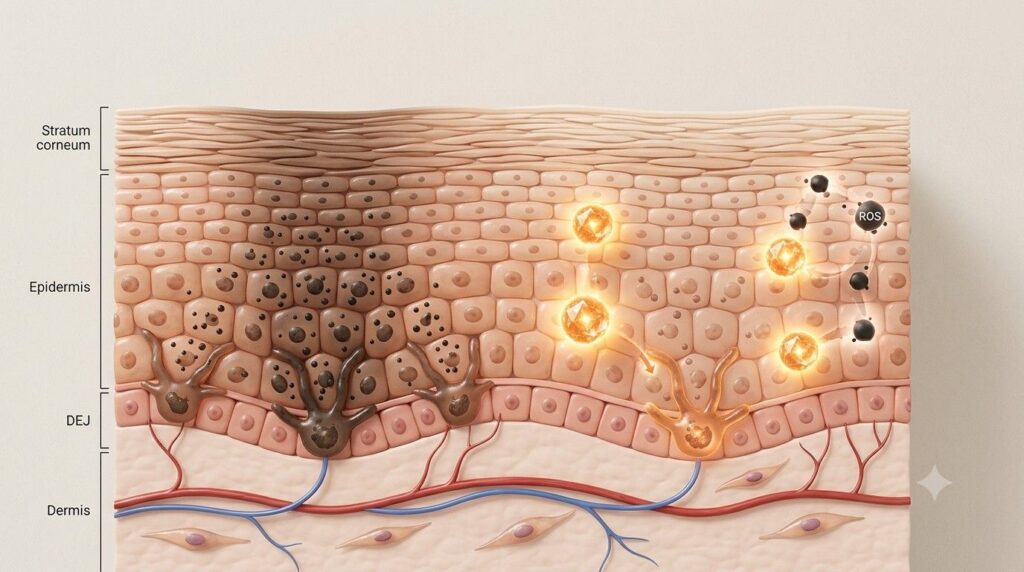
But Vitamin C does not stop there. It also chemically reduces already-formed melanin pigments — effectively fading dark spots that already exist, not just preventing new ones. This dual action (prevention + correction) is what makes it uniquely powerful compared to many single-mechanism brightening ingredients.
The third layer of Vitamin C’s anti-pigmentation power is its role as an antioxidant. When UV radiation hits skin, it generates free radicals — unstable molecules that trigger melanocyte activity and cause oxidative DNA damage. Vitamin C neutralises these free radicals before they can signal melanocytes to produce more pigment. This is why Vitamin C works synergistically with sunscreen: SPF blocks UV rays physically, while Vitamin C neutralises any UV-induced oxidative stress that gets through. Used together, they provide dramatically better anti-pigmentation protection than either ingredient alone.
Read this: How Diet Affects Skin Health
3. The Different Forms of Vitamin C — Which Is Best for Indian Skin?
Walk into any Indian pharmacy or browse any skincare website and you will see dozens of products labelled ‘Vitamin C.’ But not all of them contain the same form of Vitamin C — and the difference matters enormously in terms of efficacy, stability, and skin compatibility.
L-Ascorbic Acid — The Gold Standard: This is the pure, most studied form of Vitamin C. It acts directly in the skin without needing to be converted, delivers the fastest and most potent results, and has the largest body of clinical research behind it. However, it is also the least stable form — it oxidises rapidly when exposed to air, heat, and light (turning the serum orange or brown). It can also be irritating, especially at high concentrations, making it less forgiving on sensitive Indian skin. When properly formulated at an acidic pH (below 3.5) and stored correctly, it is unquestionably the most effective anti-pigmentation option available.

Sodium Ascorbyl Phosphate (SAP): SAP is a stable salt form of Vitamin C that converts into ascorbic acid once absorbed by the skin. It is significantly more stable than L-ascorbic acid, far gentler, and an excellent option for acne-prone and sensitive Indian skin types. It is slightly less potent than pure L-ascorbic acid, but its superior tolerability makes it ideal for beginners and those who experienced irritation with pure forms. Many Indian dermatologists prefer SAP for patients with reactive or darker skin tones, specifically because it reduces PIH risk from irritation.
Ascorbyl Glucoside: This form works through enzymatic conversion — skin enzymes break it down into active Vitamin C. It is very gentle, very stable, and particularly suited to sensitive and reactive skin types. Results are somewhat slower, but this form is excellent for long-term maintenance and as a starter form for those new to Vitamin C or those with easily irritated Indian skin.
Ethyl Ascorbic Acid: A newer derivative that offers excellent stability combined with high bioavailability — it penetrates the skin more efficiently than many other derivatives. Research is still growing but is promising. It combines much of the efficacy of L-ascorbic acid with much better stability and skin compatibility, making it increasingly popular with dermatologists treating Indian skin.
Ascorbyl Tetraisopalmitate: The fat-soluble form of Vitamin C — it penetrates deeper into skin layers than water-soluble forms. It is extremely stable, works well in creams and facial oils, and is particularly effective for anti-ageing alongside its brightening properties. Results are gradual but consistent, making it ideal for dry skin types and those seeking a comprehensive anti-ageing and anti-pigmentation approach.
RECOMMENDATION FOR INDIAN SKIN
If you are new to Vitamin C, start with Sodium Ascorbyl Phosphate (SAP) at 10–20% or Ascorbyl Glucoside. These are stable, gentle, and well-tolerated by Indian skin. Once your skin adjusts and you are comfortable, you can explore L-Ascorbic Acid (10–15%) for faster, more potent results.
4. Choosing the Right Concentration
Concentration is one of the most misunderstood aspects of Vitamin C skincare. More is not always better — especially for Indian skin where over-irritation can trigger the very PIH you are trying to treat. Here is a practical guide:

| Concentration | Who Should Use It | Expected Results | Caution Level |
|---|---|---|---|
| 5–8% | Beginners, sensitive skin, teenagers, reactive skin | Gradual brightening; mild PIH improvement over 3–4 months | Very Low — minimal irritation risk |
| 10–15% | Most Indian skin types — the sweet spot for efficacy + safety | Noticeable brightening in 4–8 weeks; good PIH reduction in 2–3 months | Low — mild tingling normal initially |
| 15–20% | Experienced users with resilient skin; moderate-severe pigment | Faster results; significant improvement in 6–8 weeks | Moderate — not for sensitive skin |
| 20%+ | Only under dermatologist supervision | Maximum potency for stubborn melasma or deep pigmentation | High — can worsen PIH if skin inflames |
5. 7 Skin Benefits of Vitamin C Beyond Just Pigmentation
Vitamin C is far more than a dark-spot eraser. It is a comprehensive skin health ingredient, and its full range of benefits makes it one of the most worthwhile additions to any skincare routine — especially for Indian skin dealing with pollution, UV exposure, and premature ageing:
Overall Skin Brightening: Vitamin C does not just target isolated dark spots — it improves the luminosity and radiance of the entire face. The dullness that accumulates from daily pollution exposure, dead skin cell buildup, and oxidative damage is visibly reduced with consistent Vitamin C use. Skin appears fresher, more awake, and healthier overall within a few weeks of starting.
Collagen Synthesis Boost: Collagen is the structural protein that keeps skin firm, bouncy, and youthful. Vitamin C is an essential cofactor in the enzymatic reactions that produce collagen. As we age and collagen naturally breaks down, Vitamin C supplementation (both topical and dietary) helps maintain collagen levels, reduce fine lines, and preserve skin elasticity — making it an equally valuable anti-ageing ingredient as an anti-pigmentation one.

Antioxidant Protection Against Pollution: India’s urban air quality index is among the worst in the world. Particulate matter, vehicle exhaust, and industrial pollution generate free radicals on the skin’s surface daily. Vitamin C neutralises these before they can trigger melanin production or cause oxidative DNA damage — acting as an invisible daily shield that no sunscreen alone can provide.
Improved Skin Hydration: Vitamin C improves the skin’s ability to retain moisture by reducing trans-epidermal water loss (TEWL). This does not replace a moisturiser, but it means skin can better hold its natural hydration — a meaningful benefit during India’s dry winter months and in air-conditioned environments that strip moisture from skin continuously.
Accelerated Wound Healing and Scar Fading: By promoting collagen synthesis and accelerating cell turnover, Vitamin C speeds up the healing of minor skin injuries and helps fade post-acne marks. For Indian skin where every pimple has the potential to leave a months-long dark mark, this healing-accelerating property is enormously valuable alongside its direct melanin-inhibiting action.
Reduction in Under-Eye Dark Circles: Vitamin C improves periorbital hyperpigmentation through two mechanisms: it reduces melanin in the area (brightening pigmentation-based dark circles) and it thickens the delicate under-eye skin through collagen stimulation, reducing the visibility of underlying blood vessels. Eye creams and serums containing Vitamin C are among the most clinically supported options for dark circles in Indian skin.
Enhancing Sunscreen Effectiveness: This is the most underappreciated benefit. Vitamin C and SPF together provide significantly better photoprotection than SPF alone. When UV light penetrates even the most diligently applied sunscreen, Vitamin C neutralises the resulting oxidative stress. Studies have shown that combining topical Vitamin C with SPF dramatically reduces UV-induced melanin stimulation — making the combination especially powerful for anti-pigmentation in sun-exposed Indian skin.
Read this: How to Apply Sunscreen Correctly
6. How to Use Vitamin C in Your Skincare Routine
Knowing what Vitamin C does is only half the equation. How and when you use it determines whether you get results or frustration. Here is a step-by-step routine designed specifically for Indian lifestyles and skin types:

Morning Routine — The Optimal Time for Vitamin C
1. Gentle Low-pH Cleanser: Begin with a sulphate-free, low-pH cleanser to remove overnight sebum, dead cells, and any residue without disrupting the skin’s acid mantle. A cleanser with a pH between 4.5 and 5.5 is ideal. Avoid soap bars, which are alkaline and make subsequent active ingredients less effective.
2. Vitamin C Serum on Damp Skin (3–4 Drops): Apply Vitamin C serum immediately after cleansing while skin is still slightly damp. Damp skin enhances absorption of water-soluble actives. Use 3–4 drops, apply with gentle patting motions across the face and neck. Do not rub or drag. Allow 2–3 minutes for the serum to fully absorb before the next step.
3. Lightweight Moisturiser: Follow with a non-comedogenic moisturiser to seal in the serum and support the skin barrier. Gel-based formulas work best for oily and combination Indian skin in warmer months. Ceramide-based moisturisers are particularly beneficial as they repair and strengthen the skin barrier — helping reduce PIH risk by preventing further skin irritation.
4. Broad-Spectrum SPF 30–50 (Non-Negotiable): This is the most critical step in any anti-pigmentation routine. If you skip SPF, you are working against Vitamin C. UV radiation continuously stimulates melanocytes — without physical UV protection, the cycle of pigmentation never breaks. Use a non-comedogenic, broad-spectrum SPF 30–50. Reapply every 2–3 hours if outdoors. For Indian skin, this single habit alone can prevent up to 90% of new pigmentation from forming.
Evening Routine — Complementary Approach
1. Double Cleanse: Start with an oil cleanser to dissolve sunscreen, makeup, and sebum. Follow with your regular water-based cleanser. A clean canvas ensures evening actives penetrate effectively rather than sitting on top of a layer of sunscreen and pollution residue.
2. Retinoid OR AHA/BHA Toner (Alternate Nights): Evening is for a different set of actives. Retinoids (adapalene 0.1% or retinol) accelerate cell turnover, helping dark spots shed faster. AHA/BHA exfoliants (glycolic, lactic, salicylic acid) remove dead skin cells that make pigmentation look darker. Use these in the evening — not the same time as Vitamin C — to avoid over-irritation. Retinoid three nights a week; BHA toner on alternate nights is a sensible starting protocol.
3. Niacinamide Serum (Evening Application): Niacinamide (Vitamin B3) at 5–10% is an excellent complement to Vitamin C. Evening niacinamide treats existing PIH, regulates sebum production, and reduces inflammation — all without the photosensitivity concern. Morning Vitamin C + Evening Niacinamide = one of the most effective anti-pigmentation duos for Indian skin.
4. Moisturiser (Slightly Richer than Morning): Night-time is when skin is in repair mode. A slightly richer moisturiser supports the barrier overnight, especially important when using retinoids or exfoliating acids. Adding 2–3 drops of rosehip seed oil to your moisturiser adds natural trans-retinoic acid and linoleic acid, complementing Vitamin C’s brightening action.
7. What to Pair with Vitamin C — And What to Avoid
Ingredient pairing is where most people make costly mistakes. Some combinations amplify Vitamin C’s effectiveness; others deactivate it or cause the irritation that worsens pigmentation on Indian skin. Here is a definitive guide:

| Ingredient | With Vitamin C? | Why |
|---|---|---|
| SPF / Sunscreen | Always — Essential | SPF blocks UV; Vitamin C neutralises UV-induced free radicals. Together they provide dramatically better anti-pigmentation protection than either alone. |
| Vitamin E | Yes — Excellent | Vitamin E stabilises Vitamin C, extends its active life in the skin, and multiplies the antioxidant effect. Many serums combine all three. |
| Ferulic Acid | Yes — Gold Standard Combo | Ferulic acid stabilises both Vitamin C and E simultaneously and has been shown to enhance their effectiveness up to 8x. Look for ‘C+E+Ferulic’ serums. |
| Niacinamide | Separate Times | Used simultaneously, they can form nicotinic acid (a yellow compound) and reduce each other’s efficacy. Morning Vitamin C, evening Niacinamide is the safest approach. |
| Retinol / Adapalene | Separate Sessions | Both are potent actives. Combined in one application they risk irritation, barrier disruption, and worsened PIH. Use Vitamin C in the morning and retinoids at night. |
| AHA / BHA Acids | Avoid Same Application | Both require acidic pH and together can over-exfoliate, disrupt the skin barrier, and cause sensitisation — especially on Indian skin prone to inflammatory responses. |
| Benzoyl Peroxide | Never Together | Benzoyl peroxide directly oxidises ascorbic acid, deactivating it completely. Use in completely separate sessions with time between them. |
| Rosehip Seed Oil | Great Pairing (Evening) | Natural source of trans-retinoic acid and linoleic acid. Applied after Vitamin C serum in the evening, it complements brightening and supports barrier repair overnight. |
Common Mistakes to Avoid When Using Vitamin C

Vitamin C is effective but unforgiving of misuse. These are the most common mistakes made by Indian skincare enthusiasts — and understanding them can mean the difference between real results and wasted products:
Skipping Sunscreen: The single most common and most damaging mistake. Vitamin C can slow melanin production, but if UV radiation continues to stimulate melanocytes without SPF protection, you are fighting a battle you cannot win. Think of it this way: Vitamin C is fixing the damage while sunscreen prevents new damage. Without SPF, you are perpetually in repair mode with no progress. This combination is non-negotiable for anti-pigmentation results in Indian skin.
Starting with Too High a Concentration: Many people assume that 20% will give twice the results of 10%. In reality, high-concentration Vitamin C on unadapted Indian skin frequently causes stinging, redness, and — critically — inflammation that triggers PIH. The very problem you are trying to fix becomes worse. Always start at 5–10%, allow 4–6 weeks for the skin to adjust, and only increase concentration if needed and tolerated.
Using an Oxidised Product: An orange or brown Vitamin C serum is not ‘still a bit active.’ An oxidised serum is entirely ineffective and may generate free radicals — meaning it can actively worsen oxidative skin damage. Check your serum at every use. Fresh L-ascorbic acid serum should be pale yellow to clear. If it has turned orange, replace it. There is no salvaging an oxidised Vitamin C serum.
Mixing with Niacinamide in the Same Application: While some modern research suggests this combination is less problematic than once thought, there remains a risk of nicotinic acid formation and reduced efficacy of both ingredients. The safer and more effective approach is morning Vitamin C, evening Niacinamide — you get the full benefit of both without any compromise.
Expecting Results in 1–2 Weeks: Pigmentation that has accumulated over months or years will not disappear in two weeks. The skin’s natural cell turnover cycle is 28–40 days (longer in adults over 30). Dark spots must work their way to the surface and shed naturally. Consistent Vitamin C use for 8–12 weeks is the minimum for noticeable improvement in most cases. Giving up at week three because you ‘don’t see results’ is the most common reason Indian skincare journeys fail.
Using Vitamin C at Night Without Morning SPF: Some people believe that applying Vitamin C at night means they do not need sunscreen the next morning. Vitamin C is not a UV filter — it neutralises free radicals but does not physically block UV radiation. SPF is always necessary, regardless of when Vitamin C is applied. If anything, active Vitamin C in your skin the following morning makes your SPF work even better — but SPF is still essential.
Read this: How to Repair Your Skin Barrier
Frequently Asked Questions
Q How long does Vitamin C take to reduce pigmentation on Indian skin?
Timeline depends on the type and depth of pigmentation. Mild PIH and recent sun tan can show noticeable improvement in 4–6 weeks of consistent daily use. Moderate pigmentation typically requires 8–12 weeks. Deep or hormonal pigmentation like melasma may take 3–6 months — and melasma often requires a multi-ingredient protocol under dermatologist supervision, not Vitamin C alone. Throughout this time, consistent SPF use is equally important and can significantly speed up the timeline.
Q Is Vitamin C safe for all Indian skin tones?
Yes, when used correctly. However, because darker Indian skin tones are more prone to PIH, any ingredient that causes irritation or inflammation can worsen pigmentation. This means the approach matters: start with lower concentrations, use gentle derivative forms if your skin is reactive, always patch test, and never skip SPF. L-Ascorbic Acid at 20% on sensitive unprepared skin is not safe — 10% SAP on the same skin is. Match the form and concentration to your skin’s current tolerance.
Q Can I use Vitamin C and Niacinamide together?
It is best to use them at different times. Apply Vitamin C in the morning and Niacinamide in the evening. This approach maximises the benefit of both ingredients — morning antioxidant protection from Vitamin C plus evening sebum regulation and PIH treatment from Niacinamide — without any risk of interaction or reduced efficacy.
Q Should I use Vitamin C every day?
Daily use provides the best results. Morning application is ideal because it provides antioxidant protection throughout the day against UV and pollution. If your skin is new to Vitamin C, begin with every other day and increase to daily once your skin has adjusted (typically 2–3 weeks). Consistency over months, not frequency in days, is what drives meaningful pigmentation improvement.
Q Can Vitamin C treat melasma effectively?
Vitamin C is a valuable component of a melasma treatment protocol, but it is rarely sufficient on its own for moderate-to-severe melasma. Dermatologists typically combine it with tranexamic acid, kojic acid, azelaic acid, or (under careful supervision) hydroquinone for meaningful improvement. Rigorous SPF use — reapplied every 2 hours when outdoors — is equally critical, as any UV exposure can undo weeks of topical treatment progress.
Vitamin C — Your Skin’s Most Loyal Daily
For Indian skin, Vitamin C is not a trend — it is three decades of clinical evidence condensed into a serum. It addresses pigmentation at the root, shields your skin from daily environmental assault, accelerates healing, and builds long-term skin health through collagen support. The key is choosing the right form, starting at the right concentration, pairing it intelligently with SPF, and committing to the consistency that results genuinely require. Dark spots did not appear overnight — and they will not disappear overnight. But with Vitamin C as a daily non-negotiable in your routine, the journey to clearer, brighter, more even-toned skin is backed by science every step of the way.
.

 Admin
Admin
[…] Read this: Vitamin C for Pigmentation […]