 Admin
Admin Introduction
You just started a new serum, every person in line finds that “holy grail” product, and within every week your pores and skin are more damaged than ever. The immediate question that follows is pretty much the same: is this a pore and skin cleanser, meaning the product actually works, or is it definitely a breakout, meaning the product won’t heal your pores and skin in any way? This precise confusion, skin cleansing vs breakouts, is one of the most common and in reality irritating dilemmas in skincare these days, and getting it incorrect can certainly imply leaving a powerful product too soon or be patient with something damaging your pores and skin with it.
Over the past few years this confusion has become all too easy with active ingredients like retinol, AHA, BHA and diet C becoming mainstream in Indian skincare workouts skincare influencers often use “it’s just a cleanser” as a blanket reason for any new breakout, which isn’t right and people to endure unnecessary infection really It can misrepresent
In this booklet we will break down what happens organically during cleansing, how it differs from proper breakouts or allergies, realistic signs and symptoms to look for in your personal skin, and dermatologist-sponsored steering to wear product against when to tackle at once Pollutants
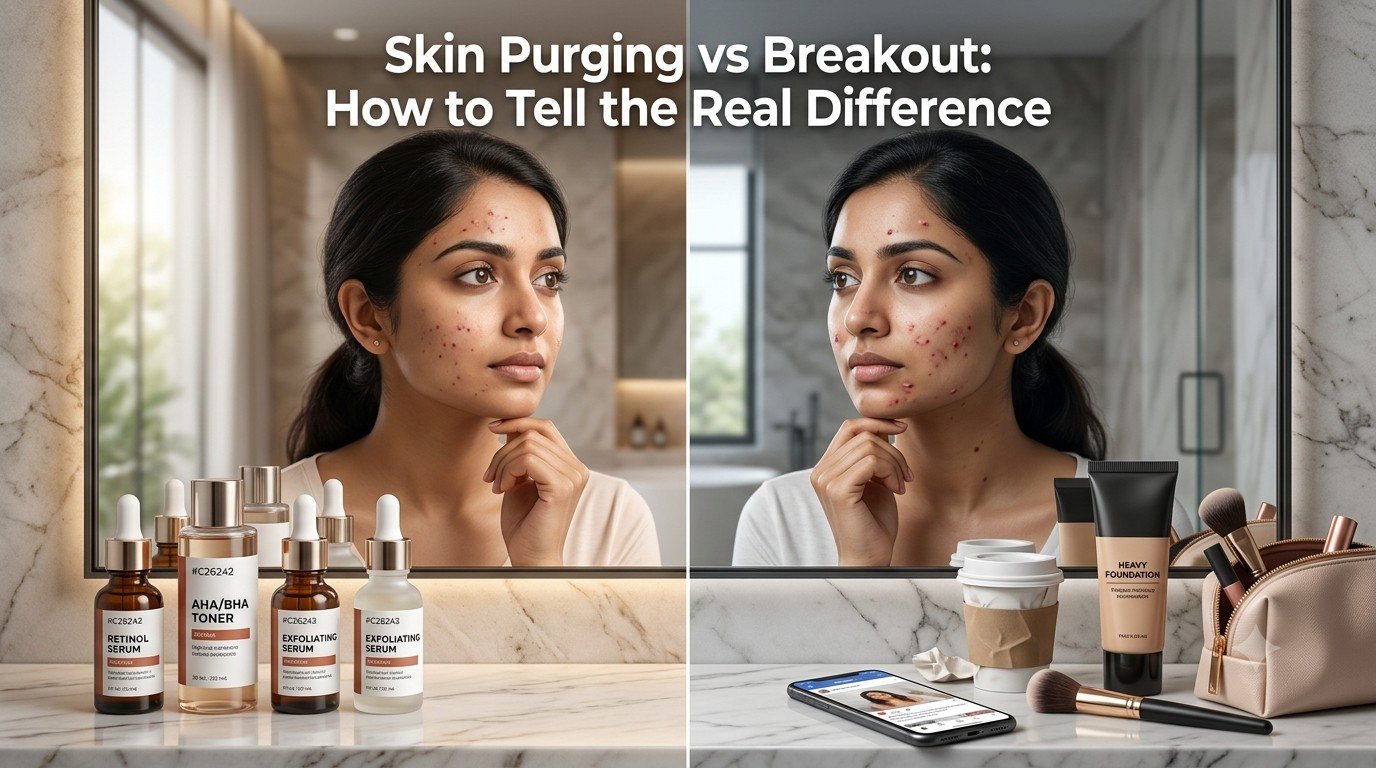
What is the difference between skin purging and a breakout?
Skin purging happens when an active ingredient speeds up skin cell turnover, temporarily pushing existing, deeper impurities to the surface faster, usually appearing in areas you already break out and clearing within four to six weeks. A breakout, on the other hand, is a reaction to an unsuitable product, appearing in new areas and worsening or persisting the longer you continue using it.
Table of Contents
- What Is Skin Purging?
- What Is a Breakout?
- Skin Purging vs Breakout: Key Differences
- Why Purging Happens: The Science Explained
- How Long Does Purging Actually Last?
- How to Tell If It’s Purging or a Reaction
- Common Mistakes People Make
- Myths vs Facts About Skin Purging
- Expert Tips for Handling Purging Safely
- When to Stop a Product or See a Dermatologist
- Conclusion
- FAQs
What Is Skin Purging?
Skin purging refers to a temporary phase of increased breakouts that occurs when certain active ingredients accelerate skin cell turnover, essentially speeding up a process your skin was already going to go through, just compressed into a shorter time frame. This typically happens with ingredients like retinol, retinoids, glycolic acid, salicylic acid, and other exfoliating actives that work by increasing the rate at which skin cells shed and regenerate.
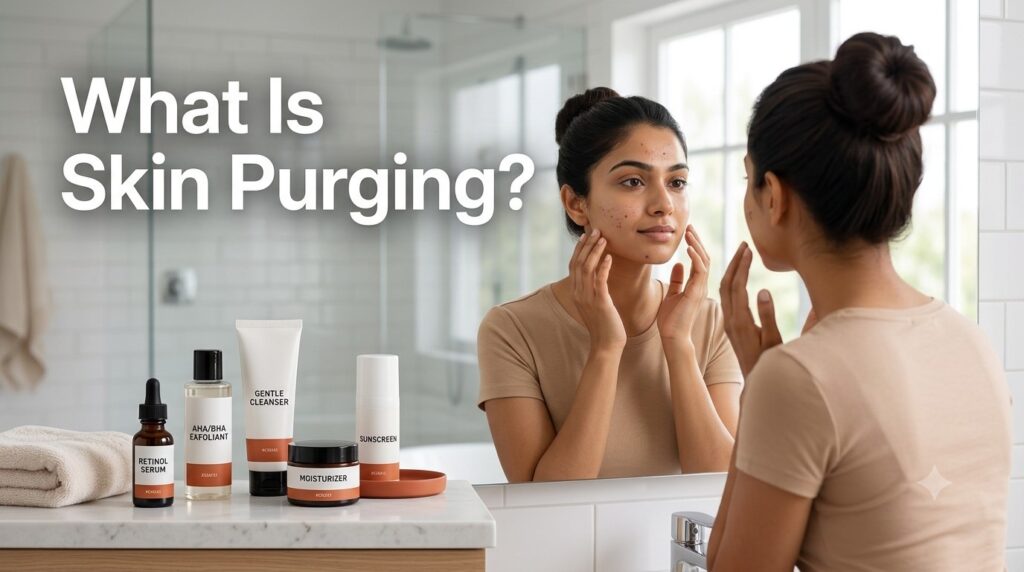
Here’s the real reason it causes visible breakouts as opposed to immediate hygiene: your skin is already riddled with microcomedones, which are tiny, invisible clogged pores that lengthen beneath the surface before they grow into visible pimples. On ordinary occasions, these could go up steadily over weeks or months. When you introduce a strong energetic aspect, it accelerates the entire system, simultaneously pushing a few of those existing microcomedones to the floor, which is why cleansing often seems to go unexpectedly worse than slow evolution.
For Indian skincare consumers in particular, cleansing is usually pronounced by switching to a new retinol serum, glycolic acid toner, or even a stronger salicylic acid cleanser for oily, acne-prone pores and skin, all increasingly in the Indian skincare market in recent years There are well-known categories The confusion often arises due to the fact that purging actually makes the same form as a bad breakup in the early days, so that it is impossible to tell the two apart from a mere unmarried perspective It’s important to note that not every invigorating ingredient produces cleansing, and not every pore and skin type makes its story despite using cleansing-sensitive elements. Specifically, cells are purified with elements that enhance turnover; It’s not with ingredients like hyaluronic acid, ceramides, simple moisturizers, because these don’t affect cell turnover in the same way
Read this: Acne vs Pimples: Key Differences, Causes & Best Treatment
What Is a Breakout?
A breakout, in contrast, is simply your skin’s negative reaction to something that doesn’t suit it, whether that’s an ingredient causing irritation, clogging pores, triggering an allergic response, or disrupting your skin’s natural barrier function. Unlike purging, a breakout has no underlying “improvement” mechanism behind it; it’s a straightforward sign that a product or ingredient is causing harm rather than working through pre-existing congestion.
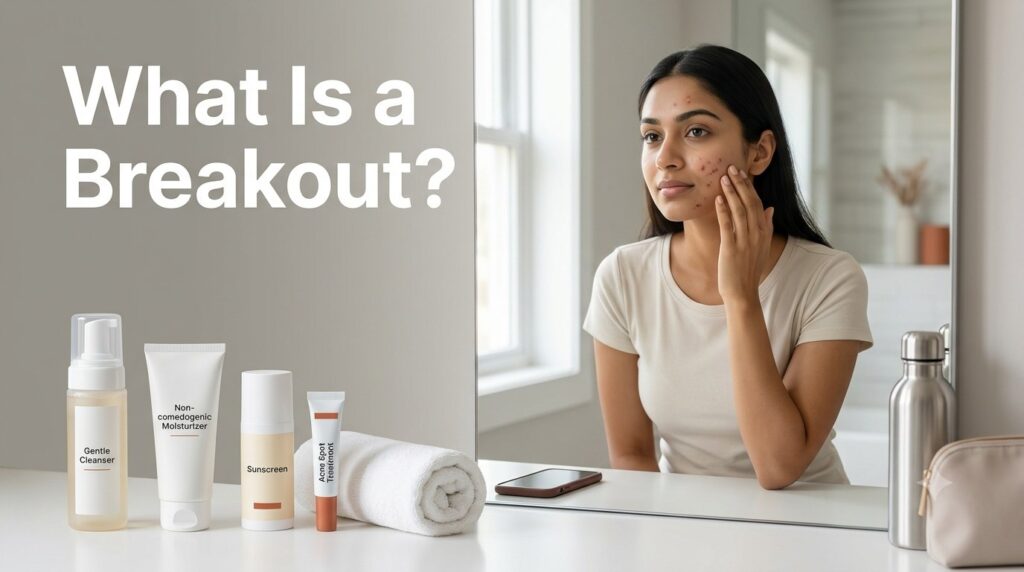
Breakdowns can occur for many wonderful reasons. Some substances, especially cheap, poorly made goods like heavy oils or some silicones, are humorous, meaning they physically clog pores, lure down sebum, dust and bacteria, develop new blockages rather than clean current This is especially relevant in humid Indian climates Creates perfect conditions for breakouts.
In other instances, fractures occur due to infection as opposed to occlusion. A product whose pH is really too harsh, an energetic ingredient added too quickly in too high a concentration, or easy allergic touch dermatitis from a perfume or preservative can all trigger inflammatory breakouts that resemble pimples yet stem from an infection rather than pore blockage.
Indian readers have a real life example of switching to new sunscreen throughout the peak summer months. Many humans experience breakouts starting a new, heavier sunscreen regime especially along brows and cheeks, especially now not suited to oily or combination pore skin, and this is a classic breakout scenario, totally unrelated to cleansing, because sunscreens usually cell turnover accelerating active ingredients There are none
Skin Purging vs Breakout: Key Differences
While both purging and breakouts can look frustratingly similar on day one, several genuine, observable differences help distinguish between them once you know what to look for.
| Factor | Skin Purging | Regular Breakout |
| Caused By | Active ingredients (retinol, AHA, BHA) | Comedogenic or irritating ingredients |
| Location | Areas you already break out | New, unusual areas |
| Duration | Improves within 4–6 weeks | Persists or worsens over time |
| Pimple Type | Smaller, faster-clearing bumps | Larger, inflamed, slow-healing bumps |
| Texture Trend | Gradually smoother despite bumps | Increasingly rough or inflamed |
| Correct Action | Continue product, monitor progress | Stop product immediately |
This comparison highlights the two most reliable indicators: location and duration. Purging tends to occur in your usual problem areas, since that’s where existing microcomedones were already forming beneath the surface, while breakouts frequently appear in entirely new areas your skin doesn’t typically struggle with, such as sudden bumps along the jawline when you’ve never had jawline acne before.
Duration is equally telling. Genuine purging follows a predictable timeline, generally improving within four to six weeks as your skin completes this accelerated turnover cycle. A breakout, by contrast, shows no such improvement pattern and instead tends to worsen the longer you continue using the offending product, since the underlying cause, whether irritation or pore-clogging, keeps compounding rather than resolving.
Why Purging Happens: The Science Explained
Understanding the underlying biology of purging helps explain why this temporary worsening phase is a genuine, expected part of using certain active ingredients rather than a sign that something has gone wrong.

Skin cell turnover, the process by which new skin cells form at the base of the epidermis and gradually migrate upward, replacing dead cells shed from the surface, normally takes around 28 to 40 days in adults, though this slows further with age. During this natural cycle, microcomedones, which are non-inflamed, invisible clogged follicles, form beneath the skin and would typically take weeks or months to surface as visible pimples on their own.
Ingredients like retinoids work by binding to specific retinoic acid receptors in skin cells, which directly signals faster cell division and turnover. Similarly, alpha and beta hydroxy acids dissolve the bonds holding dead skin cells together, encouraging quicker shedding of the surface layer. Both mechanisms essentially compress what would normally be a gradual, months-long surfacing process into a much shorter window of just a few weeks.
This is precisely why purging tends to resolve faster than a genuine acne breakout caused by ongoing irritation or clogging. Once the existing backlog of microcomedones has been pushed to the surface and cleared, there’s no continued mechanism causing new ones to form at the same accelerated rate, and skin generally settles into a calmer, clearer state, provided the active ingredient is otherwise suited to your skin type.
Read this: Foods That Help Reduce Pigmentation
How Long Does Purging Actually Last?
One of the most practical questions people have is simply how long they should tolerate worsening skin before concluding it isn’t purging after all, and having a realistic timeline genuinely helps prevent both premature product abandonment and unnecessary prolonged irritation.
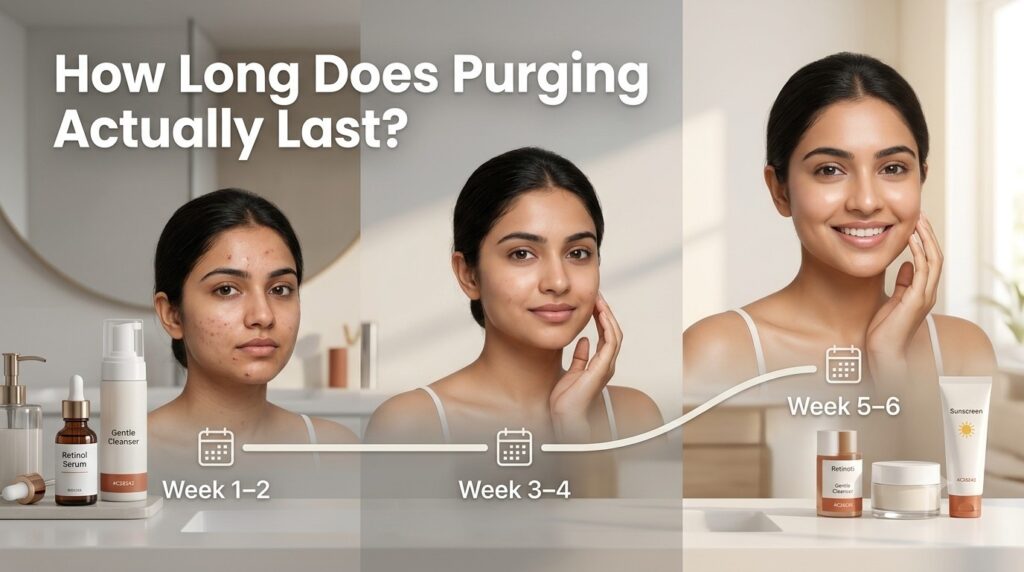
Generally, dermatologists suggest that genuine purging should show noticeable improvement within four to six weeks of consistent use. This timeline aligns reasonably well with the skin’s natural cell turnover cycle, meaning by this point, most of the existing microcomedones that were going to surface due to accelerated turnover should have done so, and new breakouts should become progressively less frequent.
If you’re using a product two to three times a week, as commonly recommended for retinol or exfoliating acids, the purging phase might extend slightly longer, sometimes up to eight weeks, simply because the accelerated turnover process itself is happening at a slower pace due to less frequent application, a relevant consideration for beginners easing into stronger actives gradually.
It’s worth noting that if breakouts show absolutely no improvement by the six-to-eight-week mark, or if they’re clearly worsening in severity or spreading to new areas during this period, this is a strong indication that what you’re experiencing is a genuine adverse reaction rather than purging, regardless of how popular or well-reviewed the product might be online.
How to Tell If It’s Purging or a Reaction
Beyond the general comparison points already discussed, a few practical, real-life observation techniques can help you make a more confident, personal assessment of what’s actually happening with your own skin.
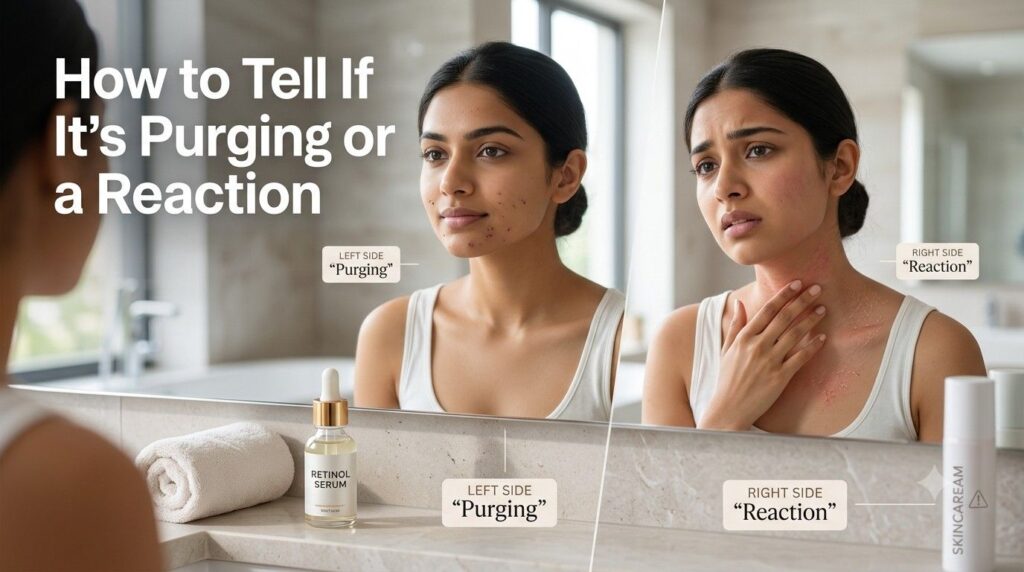
Pay close attention to whether the new bumps appear in areas where you’ve historically experienced breakouts. For example, if you typically get occasional pimples along your chin and jawline, and your new retinol serum causes a temporary flare-up specifically in these same areas, this pattern strongly suggests purging rather than a fresh reaction, since it aligns with pre-existing congestion in your usual trouble spots.
Consider also how quickly individual pimples resolve. Purging-related bumps tend to be smaller, come to a head faster, and clear within a few days, following a pattern similar to how a typical, mild pimple would normally behave, just occurring more frequently during this phase. Breakout-related bumps, especially those caused by irritation or allergic reaction, often appear larger, more inflamed, itchier, or accompanied by visible redness and sometimes a burning sensation that doesn’t fit your skin’s usual acne pattern.
Keeping a simple weekly photo diary, taken in consistent lighting, genuinely helps track objective progress over the four-to-six-week window rather than relying purely on how your skin feels day to day, since daily fluctuations can feel discouraging even when overall improvement is genuinely happening beneath the surface.
Read this: How to Remove Pimples on Face Naturally and Fast
Common Mistakes People Make
Several recurring mistakes make it harder for people to correctly distinguish purging from breakouts, often leading to either premature product abandonment or unnecessarily prolonged skin damage.

One frequent mistake is introducing multiple new active ingredients simultaneously, such as starting a retinol serum and a new vitamin C product in the same week. This makes it genuinely impossible to identify which ingredient is responsible for any resulting breakout, whether it’s purging from one product or an adverse reaction to the other, leaving you unable to make an informed decision about what to continue or discontinue.
Another common error is assuming every single new breakout after starting an active ingredient must be purging, simply because that explanation feels more encouraging than admitting a popular, expensive product doesn’t suit your skin. This assumption can lead people to continue using genuinely irritating products for months, worsening inflammation and potentially causing lasting damage to their skin barrier.
Many people also apply active ingredients too frequently right from the start, using a strong retinol nightly instead of gradually building up from twice a week, which can trigger a more severe, prolonged reaction that becomes genuinely difficult to distinguish from typical purging due to its heightened intensity.
Lastly, discontinuing a product at the very first sign of any breakout, without giving it the reasonable four-to-six-week window that genuine purging requires, often means abandoning products that would have eventually delivered real improvement, simply due to impatience during the initial adjustment phase.
Myths vs Facts About Skin Purging
Given how frequently purging is discussed online, often incorrectly, separating genuine dermatological understanding from popular misconceptions is essential for making informed skincare decisions.

Myth 1: Any breakout after starting a new product is automatically purging. Fact: Only ingredients that increase cell turnover, such as retinoids and exfoliating acids, cause genuine purging. Breakouts from moisturizers, sunscreens, or cleansers are not purging and indicate the product doesn’t suit your skin.
Myth 2: Purging can last for several months. Fact: Genuine purging typically resolves within four to six weeks. Prolonged worsening beyond this period usually indicates an adverse reaction rather than purging.
Myth 3: The worse the purging, the better the product is working. Fact: Severe, painful, or widespread breakouts are not a sign of superior effectiveness; they often indicate the active ingredient concentration or frequency is too aggressive for your skin and should be adjusted.
Myth 4: You should push through purging no matter how uncomfortable it gets. Fact: While mild purging is expected, severe pain, swelling, or signs of infection should never simply be tolerated and warrant discontinuing the product and consulting a dermatologist.
Myth 5: Purging only happens with expensive, high-end skincare products. Fact: Purging depends entirely on the active ingredient and its concentration, not the product’s price point. Both affordable and premium retinol or acid-based products can equally trigger purging.
Expert Tips for Handling Purging Safely
Dermatologists generally recommend a cautious, gradual approach when introducing purging-prone ingredients, which significantly reduces the severity of this adjustment phase without eliminating it entirely.
Introducing new active ingredients like retinol or glycolic acid gradually, starting with just twice-weekly application for the first two to three weeks before slowly increasing frequency, allows your skin to adjust more smoothly and often results in milder, more manageable purging compared to starting with daily use immediately.
Avoiding the introduction of multiple new active ingredients at the same time remains one of the most valuable pieces of advice, since this allows you to clearly identify which specific product is responsible for any changes in your skin, whether positive improvement or a genuine adverse reaction requiring discontinuation.
Maintaining a consistent, gentle supporting routine during the purging phase, including a proper moisturizer and daily sunscreen, helps minimize additional irritation and supports your skin barrier while it goes through this accelerated turnover process, rather than adding further stress through harsh cleansers or additional exfoliants during this sensitive window.
Finally, resisting the urge to pick, squeeze, or pop purging-related pimples remains important, since manual manipulation increases the risk of scarring and secondary infection, regardless of whether the underlying cause is purging or a genuine breakout.
When to Stop a Product or See a Dermatologist
While mild purging is a normal, expected phase, certain warning signs genuinely indicate it’s time to stop a product immediately and, in some cases, consult a dermatologist rather than waiting out the typical four-to-six-week timeline.

If you experience severe swelling, intense burning, blistering, or signs of an allergic reaction such as widespread hives or significant facial swelling, discontinue the product immediately regardless of how long you’ve been using it, since these symptoms indicate a genuine adverse reaction rather than expected purging.
If breakouts show absolutely no improvement, or continue worsening, beyond the six-to-eight-week mark despite consistent, correctly gradual use, this strongly suggests the product simply doesn’t suit your skin, and continuing use is unlikely to yield the benefits you’re hoping for, making discontinuation the sensible next step.
Anyone dealing with persistent, severe, or cystic acne, whether newly triggered or pre-existing, should consult a dermatologist rather than relying solely on over-the-counter active ingredients and online guidance, since underlying hormonal or other medical factors may require targeted prescription treatment beyond what any retail skincare product can address.
Read this: How to Repair Your Skin Barrier
Conclusion
Understanding the difference between skin purging vs breakout genuinely empowers you to make better, more confident skincare decisions rather than either abandoning effective products too early or tolerating harmful ones for too long. Purging occurs specifically with active ingredients that accelerate cell turnover, typically appears in your usual problem areas, and resolves within four to six weeks. A breakout, by contrast, often appears in new areas, shows no improvement over time, and signals that a product simply doesn’t suit your skin. Paying close attention to location, duration, and severity, while introducing new actives gradually and one at a time, remains the most reliable way to tell these two very different skin responses apart.
FAQs
1. What is the main difference between skin purging vs breakout?
Purging occurs with active ingredients that speed up cell turnover and resolves within four to six weeks, while a breakout is an adverse reaction to an unsuitable product that persists or worsens over time.
2. Does purging happen with all skincare products?
No, purging only occurs with ingredients that increase skin cell turnover, such as retinol, glycolic acid, and salicylic acid. Moisturizers, sunscreens, and cleansers typically don’t cause purging.
3. How long does skin purging usually last?
Genuine purging typically improves within four to six weeks of consistent use, though it may extend slightly longer with less frequent application of the active ingredient.
4. Can purging occur in new areas of the face?
Purging generally occurs in areas you already experience breakouts, since it involves existing microcomedones surfacing faster. New, unusual breakout areas usually indicate a genuine reaction instead.
5. Should I stop using a product if I think I’m purging?
If the reaction is mild and occurs in your usual problem areas, continuing for four to six weeks while monitoring progress is generally recommended, unless you experience severe irritation or no improvement.

 Admin
Admin