
 Admin
Admin Natural skincare routine
To be honest, I have seen people spend thousands of rupees on branded serums and creams, and still wake up with dull, uneven skin. And I’ve seen people with gorgeous, glowing skin who spend next to nothing. It’s simply because they understand one thing: what your skin needs isn’t necessarily what the beauty industry is selling you.A good natural skincare routine doesn’t mean stocking up on 15 products or a 10-step Korean beauty regimen. It’s about understanding your skin, using the right natural ingredients and being consistent. When you give your skin what it really needs – gentle cleansing, real hydration, food from the earth, and shelter from the sun, it answers. It starts glowing not due to any miracle product but because a healthy skin barrier finally has the chance to do its job.
In this guide, I am going to take you through everything you need to build a natural skincare routine that actually works – for Indian skin, in Indian weather, with ingredients you can actually find and afford. Whatever it is, dryness, pigmentation, acne or just dullness this is your launch pad.
Why Choose a Natural Skincare Routine?

That’s a fair question, and I don’t want to just throw buzzwords at you. The truth is, natural skincare works not because natural is good and chemical is bad. That’s a little oversimplified. But there is a subtler reason for this.
Most drug store and even premium skin care products are filled with synthetic fragrances, artificial preservatives like parabens, alcohol, sulphates and colourants – not because these ingredients are good for your skin, but because they make the product smell nice, feel smooth and look pretty on a shelf. Many of these additives are the same things that cause sensitivity, breakouts and long-term barrier damage in already stressed Indian skin due to pollution, sun exposure and humidity changes.
Natural ingredients, on the other hand – raw honey, aloe vera, rose water, besan, haldi, argan oil and jojoba oil – work with the chemistry of your skin, not against it. They work, which is why they’ve been used for centuries in Ayurveda and traditional Indian homes. Modern dermatology is now catching up and scientifically proving many of these ingredients.
That said, a natural skincare routine does not mean DIY everything. It means choosing products with clean, recognisable ingredients, supplemented thoughtfully with kitchen remedies where appropriate.
Morning Natural Skincare Routine — Step by Step
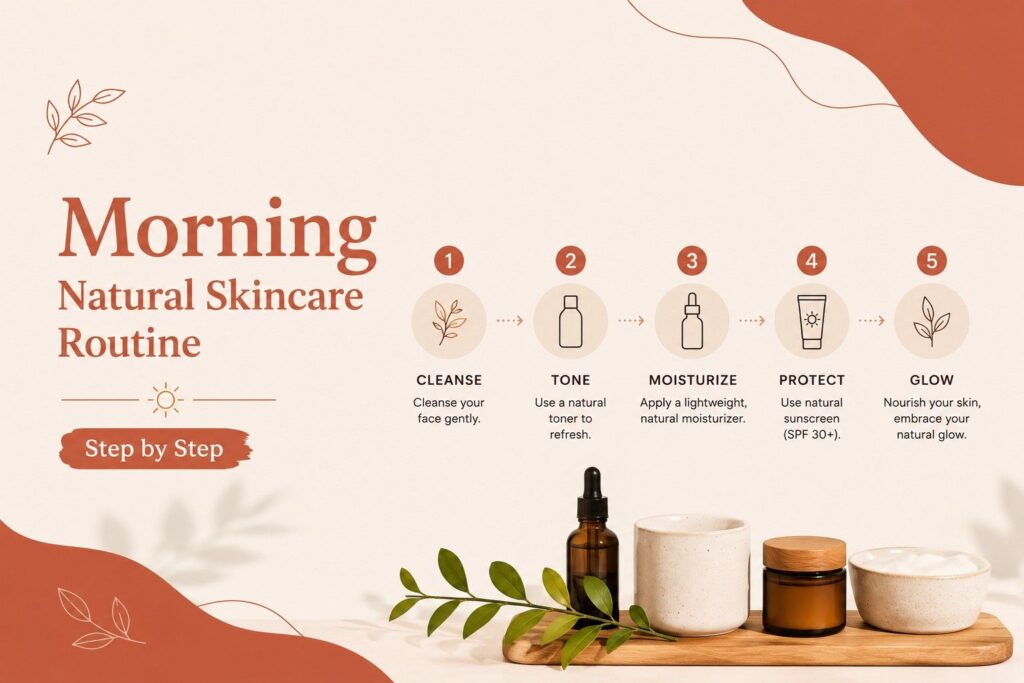
Your morning routine has one core job: prepare your skin to face the day. – Gentle cleansing, layering hydration, and, most importantly, UV protection for your skin. Here’s exactly how to do it the natural way.
Step 1: Rinse or Wash Gently
You don’t need to deep-cleanse your skin in the morning. If you don’t experience a lot of night sweats, a quick rinse with cool water or a very mild, sulfate-free cleanser is all you need. Harsh cleansers strip the skin of its natural oils (sebum) and your skin tries to compensate by producing even more oil – leading to either more dryness or more breakouts depending on your skin type.
Natural Alternative: Mix a teaspoon of raw besan flour with a few drops of rose water and a tiny pinch of turmeric. Massage into wet skin. Rinse. This is one of the oldest cleansing traditions of India and works wonders for most skin types.
Step 2: Hydrating Toner
A toner is not just a marketing gimmick – for Indian skin exposed to hard water, pollution and temperature variations, a good toner rebalances the pH after cleansing and helps the skin absorb the next steps more effectively.
Natural alternative: Spritz or pat pure rose water on your skin with clean hands – it’s really one of the best toners you can use. It has anti-inflammatory and mild antibacterial properties and helps with redness and puffiness. Look for distilled rose water with no glycol.
Step 3: Vitamin C or Antioxidant Serum
During the day, your skin is most exposed to oxidative stress from UV rays, pollution and heat. The antioxidant layer works to combat free radical damage, while fading hyperpigmentation and improving skin tone over time. This step is especially helpful for Indian skin that is prone to dark spots and uneven tone.
Natural alternative: A few drops of pure rosehip oil or sea buckthorn oil work beautifully as natural Vitamin C and antioxidant sources. If your skin is oily, apply just 2-3 drops and let it absorb for 60 seconds before the next step.
Step 4: Moisturiser
Even if your skin is oily, you need a moisturiser in the morning. The goal is not to add grease — it is to reinforce the skin barrier so your skin does not lose water throughout the day. For dry skin, choose a richer cream. For oily or combination skin, a lightweight gel moisturiser or aloe-based formula works better.
Natural alternative: Pure aloe vera gel (fresh, scooped directly from the leaf) works as an excellent lightweight moisturiser for oily-to-normal skin. For dry skin, mix 1 teaspoon aloe with a few drops of sweet almond or jojoba oil.
Step 5: Sunscreen — The Non-Negotiable
I want to be very direct about this: no natural skincare routine is complete without sunscreen. There is no natural SPF ingredient that provides adequate broad-spectrum protection. Sunscreen is the single most evidence-backed skincare product there is. It prevents hyperpigmentation, premature ageing, and — most critically — skin cancer.
Use a mineral sunscreen with zinc oxide or titanium dioxide, SPF 30 at minimum, SPF 50 if you spend time outdoors. Apply it as the absolute last step of your morning routine. This one step alone will do more for your skin long-term than any serum or treatment you could add..
Read this: Best Skin Care Tips and Routine for Glowing & Healthy Skin
Night Natural Skincare Routine — Step by Step

Your night routine is where the real repair happens. While you sleep, your skin’s cell turnover increases, blood flow to the skin improves, and it is far more receptive to nourishing ingredients. This is the time to go deeper.
Step 1: Oil Cleanse or Double Cleanse
If you wore sunscreen or any product during the day, start with an oil cleanser. Oils dissolve oils — meaning sunscreen, pollution particles, and sebum all come away cleanly. Follow up with your gentle cleanser to remove any residue. If you only wore rose water and moisturiser, a single gentle cleanse is fine.
Natural alternative: Massage a teaspoon of cold-pressed coconut oil or sunflower oil on dry face for 60 seconds, then remove with a warm, damp muslin cloth. Follow with the besan cleanser from your morning routine.
Step 2: Exfoliation (2-3 Times a Week)
Removing dead skin cells is essential — without it, your skin looks dull, other products cannot absorb properly, and pores can become clogged. But over-exfoliating is one of the biggest mistakes people make (more on that later). Twice a week is plenty for most people.
Natural alternative: Mix 1 teaspoon of fine oat powder with yoghurt and a drop of honey. Rub gently in circular motions for 30 seconds and rinse. This is one of the gentlest yet most effective natural exfoliants — the lactic acid in yoghurt works chemically while oats provide physical texture.
Step 3: Toner or Essence
Same as the morning — rose water, or a hydrating essence if you enjoy the texture. At night, you can also use a green tea toner, which is loaded with EGCG (epigallocatechin gallate), a powerful antioxidant that repairs UV damage accumulated through the day.
Natural alternative: Brew strong green tea, let it cool completely, and use it as a toner. Store in the fridge and use within 3 days.
Step 4: Face Mask (2-3 Times a Week)
This is where your natural skincare routine really gets to shine. A targeted face mask 2-3 times a week — tailored to your skin’s current needs — delivers concentrated ingredients while you wind down for the night.
Quick mask guide by concern:
- Dullness: Papaya pulp + honey + a pinch of turmeric (15 minutes)
- Dryness: Mashed banana + raw cream (malai) + almond oil (20 minutes)
- Acne-prone skin: Multani mitti + rose water + neem powder (10-12 minutes)
- Pigmentation: Potato juice + yoghurt + lemon juice — but apply only at night (15 minutes)
- Sensitive skin: Cucumber pulp + aloe vera gel (20 minutes)
Step 5: Night Serum or Treatment
At night, you can use slightly more active ingredients that you would not use in the day. Bakuchiol — a natural plant extract from the babchi plant — is a proven Retinol alternative that stimulates collagen, reduces fine lines, and improves skin tone, without the irritation retinol often causes. It is safe for even sensitive skin types.
Natural alternative: Look for bakuchiol oil or a bakuchiol serum. Apply 3-4 drops and press gently into skin. If you are on a budget, pure rosehip oil applied nightly delivers similar slow but consistent results.
Step 6: Rich Moisturiser or Night Cream
At night, you can use a heavier, richer formula than your daytime moisturiser. The goal is barrier repair and deep nourishment. Shea butter, ceramide creams, or a thick aloe-based moisturiser all work well depending on your skin type.
Step 7: Facial Oil (Sealing Step)
The very last step — a few drops of a nourishing oil pressed into the skin to lock everything in. Think of it as a sealing layer. Best oils for different skin types: rosehip (for pigmentation and anti-ageing), argan (for dry and mature skin), jojoba (for oily and combination skin, as it mimics sebum). Apply after moisturiser, not before.
Your Full Natural Skincare Routine at a Glance

| Step | Product Type | Morning (AM) | Night (PM) |
| 1 | Cleanser | Cool water or besan wash | Oil cleanse + gentle cleanse |
| 2 | Toner | Rose water | Rose water or green tea toner |
| 3 | Treatment | Rosehip oil / Vit C | Bakuchiol or treatment serum |
| 4 | Moisturiser | Aloe gel or light cream | Rich night cream or balm |
| 5 | Protection | SPF 30-50 (mandatory) | Face mask 2-3x/week |
| 6 | Seal | — | Facial oil (rosehip / argan) |
Practical Skincare Tips Specifically for Indian Skin

Indian skin is beautifully diverse — ranging from fair to deep brown across the Fitzpatrick scale — but it does share some common tendencies that affect how you should approach your natural skincare routine. Here is what most generic Western skincare guides will not tell you:
1. Indian skin is highly prone to hyperpigmentation. Any inflammation — whether from acne, a rash, a cut, or even friction — leaves a dark mark that can take months to fade. This is called Post-Inflammatory Hyperpigmentation (PIH). Prevention is easier than cure: avoid picking at skin, always use SPF, and treat active acne early.
2. Our climate demands seasonal adjustment. India has dramatically different seasons. In winter and AC-heavy offices, skin gets dry and dehydrated. In monsoon and summer, humidity spikes and oiliness increases. Your skincare routine should change — lighter in summer and monsoon, richer in winter. One routine year-round will leave you either greasy or parched depending on the season.
3. Hard water is quietly damaging your skin. Most Indian cities have hard water — water with high mineral content. This disrupts the skin’s pH, strips natural oils, and contributes to dullness and sensitivity. Use a gentle, pH-balanced cleanser and always follow up with rose water or a toner. Installing a shower filter is genuinely worth considering.
4. Traditional ingredients like besan, haldi, and malai are not just folklore. Chickpea flour gently exfoliates. Turmeric has documented anti-inflammatory and antibacterial properties (just use very small amounts to avoid staining). Raw milk cream (malai) is rich in lactic acid and fats that nourish dry skin. These ingredients have survived centuries of use because they work — use them with confidence.
5. Coconut oil is not for everyone’s face. Coconut oil is highly comedogenic (pore-clogging) for many people, especially those prone to acne or having oily skin. If it breaks you out, switch to jojoba oil, almond oil, or squalane — all are non-comedogenic and excellent for Indian skin.
6. Pollution-related dullness needs antioxidants. Living in Indian cities means daily exposure to PM2.5, smoke, and dust. These particles generate free radicals that break down collagen and cause dullness. Antioxidant-rich ingredients — Vitamin C, green tea, rosehip oil, niacinamide — are essential, not optional, for urban Indian skin.
Common Skincare Mistakes That Are Wrecking Your Skin

In years of reading about skincare and talking to dermatologists, these are the mistakes I see repeated most often — and they are all completely avoidable:
Over-exfoliating: The number one mistake. Scrubbing your face with walnut scrubs, apricot face washes, or using AHAs every single day destroys your skin barrier. Signs you have over-exfoliated: sudden redness, tightness, burning sensation, or random breakouts where you did not have them before. Scale back to twice a week maximum.
Skipping sunscreen because ‘it is cloudy today’: UV rays penetrate clouds. They also penetrate glass windows. If you are indoors near windows, you are still getting UV exposure. SPF is a daily, non-negotiable step — not a beach trip thing.
Using lemon juice directly on skin: Lemon is acidic enough (pH around 2) to cause chemical burns and severe photosensitivity. A lot of Indian home remedies call for ‘lemon on dark spots’ — please do not do this. If you want Vitamin C benefits, use a diluted Vitamin C serum or rosehip oil instead.
Washing face too many times a day: Your sebum is not your enemy — it is there to protect you. Washing 3-4 times a day strips it away completely, forcing your skin into overdrive. Twice a day is the maximum for most people.
Changing products every two weeks: Skincare ingredients need time to work. Most actives need 4-6 weeks before you see results, and a full skin cycle (28 days) before your skin truly adapts. If you switch products every time you see a new ‘holy grail’ video, you will never know what is actually working.
Applying products in the wrong order: Thinnest to thickest — always. Toner → serum → moisturiser → oil. Applying oil before your serum creates a barrier that prevents the serum from absorbing at all.
Not moisturising oily skin: This is a very common misconception. Oily skin still needs moisture — it is producing oil precisely because it is dehydrated and overcompensating. A lightweight, oil-free moisturiser will actually help regulate oil production over time.
Who Should Be Careful With DIY Natural Remedies?

I want to be clear about something: just because something is natural does not mean it is safe for everyone. There are situations where DIY remedies can do more harm than good, and you need to know if you fall into one of these categories:
Important: Always do a patch test on your inner arm for 24 hours before applying any new DIY ingredient to your face — even if it sounds completely harmless.
People with active eczema or psoriasis: These are medical conditions with compromised skin barriers. Many natural ingredients — including some essential oils, citrus, and even honey — can trigger flares. Please consult a dermatologist before introducing any new topical ingredient.
Those with a known allergy to nuts or latex: Almond oil, coconut oil, and avocado-based remedies should be avoided by people with tree nut allergies. Aloe vera can cause reactions in people with latex sensitivity.
People with rosacea: Rosacea skin is hypersensitive and reactive. Spicy, warming, or strongly antibacterial ingredients — including neem oil, peppermint, tea tree oil, and turmeric — can trigger flares. Even rose water can occasionally irritate severe rosacea.
Pregnant or breastfeeding individuals: Essential oils like rosemary, clary sage, peppermint, and tea tree should be used with caution or avoided during pregnancy. Always check with your OB-GYN before using any new skincare ingredient.
People on prescription retinoids or acne medication: If you are on tretinoin, isotretinoin (Accutane), or antibiotic creams, your skin is already under chemical load. Layering DIY acids, turmeric, or citrus on top can cause irritation, chemical burns, or unpredictable reactions. Stick to the simplest, gentlest products.
Anyone with open wounds, active cystic acne, or broken skin: Do not apply DIY masks on compromised or open skin. Let it heal first. Face packs on open acne pustules can introduce bacteria and worsen infection.
Frequently Asked Questions
Q: Can I build a complete natural skincare routine only using kitchen ingredients?
A: Mostly yes, but with one major exception — sunscreen. You cannot replicate broad-spectrum SPF protection with kitchen ingredients. Everything else — cleansing, toning, treating, and moisturising — can absolutely be done with thoughtfully chosen natural ingredients. Think of sunscreen as the one non-negotiable modern addition to an otherwise natural routine.
Q: How long before I see results from a natural skincare routine?
A: Your skin renews itself every 28 days, so give any new routine a minimum of 4-6 weeks before judging results. You will likely notice smaller improvements first — better hydration, less tightness, reduced redness — within the first two weeks. Significant changes in texture, tone, and pigmentation take longer, often 8-12 weeks of consistency.
Q: Is a natural skincare routine suitable for oily, acne-prone skin?
A: Yes, but choose your ingredients carefully. For oily or acne-prone skin, stick to lightweight, non-comedogenic options like aloe vera, jojoba oil, green tea, neem, and multani mitti. Avoid heavy oils like coconut oil, almond oil in large amounts, or anything with butter textures that can clog pores.
Q: My skin is very dark and uneven. Can natural skincare help with pigmentation?
A: Absolutely — but it requires patience. Ingredients that help with hyperpigmentation in a natural routine include: Vitamin C (rosehip oil, amla), licorice root extract, kojic acid (from rice water or fermented rice), and consistent SPF use. Nothing works faster than preventing new dark spots in the first place.
Q: Should I change my natural skincare routine in summer versus winter in India?
A: Definitely. In Indian summers and monsoon, switch to lighter textures — gel moisturisers, oil-free formulas, minimal oils. In winter, especially in northern India, upgrade to richer creams, add a facial oil as a last step, and consider a hydrating sleeping mask 2-3 nights a week. Your routine should breathe with the seasons.
Q: Is rice water actually good for skin or is it a social media trend?
A: Rice water has genuine merit. It contains inositol (a carbohydrate that penetrates the skin and may help with anti-ageing), and fermented rice water has mild kojic acid content that can help with brightening. Use it as a toner after cleansing. Store in the fridge and use within 3 days. It is not magic, but it is genuinely useful.
Final Thoughts: Glow Is a Habit, Not a Product

Here is the truth that most skincare brands do not want you to hear: your skin does not need more products. It needs the right products, used consistently, with a little patience and self-awareness.
A natural skincare routine is not about going back to the Stone Age or rejecting all of modern skincare. It is about being intentional — choosing ingredients that genuinely support your skin, building habits that protect and nourish it daily, and trusting the process enough to stick with it long enough to see results.
Start simple. A gentle cleanser, rose water, a basic moisturiser, and SPF. Get those four steps right consistently for four weeks. Then layer in treatments, serums, and masks one at a time. Listen to how your skin responds. Adjust what is not working.
Your skin is telling you what it needs every single day — dryness, oiliness, breakouts, sensitivity, dullness. A good natural skincare routine teaches you to listen to it, and then answer thoughtfully. That is when the glow happens — not because of a product, but because your skin is genuinely healthy.

 Admin
Admin
[…] Read this: Natural Skincare Routine for Healthy & Glowing Skin […]
[…] Read this: Natural Skincare Routine for Healthy & Glowing Skin […]
[…] Read this: Natural Skincare Routine for Healthy & Glowing Skin […]